This course will engage a class of writing that everybody is familiar with ever since their their childhood: the fairy tale. We all grew with fairy tales, either told by our parents or grandparents, or seen in their screen versions on TV or in movie theatres.
We all followed the Harap Alb’s fantastic journey and met his bizzare companions. Girls were taught lessons of prudence by means of Little Red Riding Hood; of how deceitful looks can be in Beauty and the Beast or Povestea porcului; of how little acts of kindness can be rewarding in Fata moșului și fata babei Boys learned about the power of words in Croitorașul cel viteaz; about help coming from the most unexpected creatures (in Puss in Boots), or the most absurd incidents (in Jack and the Beanstalk).
Yet this course will deal only briefly with the folk tale, the tale that has no author and is circulated orally among many people. We will define the fairy tale, will see how it can be classified, how its structure has been analyzed; and in how many ways we could approach fairy tales.
But it is the literary fairy tale that will make the bulk of this course. Fairy tales that have a known author, often a sophisticated writer, that might either play with the old tradition, or just set out to invent completely new fairy tales.
We will follow the first collectors that were never just passive collectors, but actually creators that laid their imprint of old folk motives. And then we will see how the creativity of the next generations increased and produced original tales, sophisticate or brutal, lyrical or rambunctious, nostalgic or ironic.
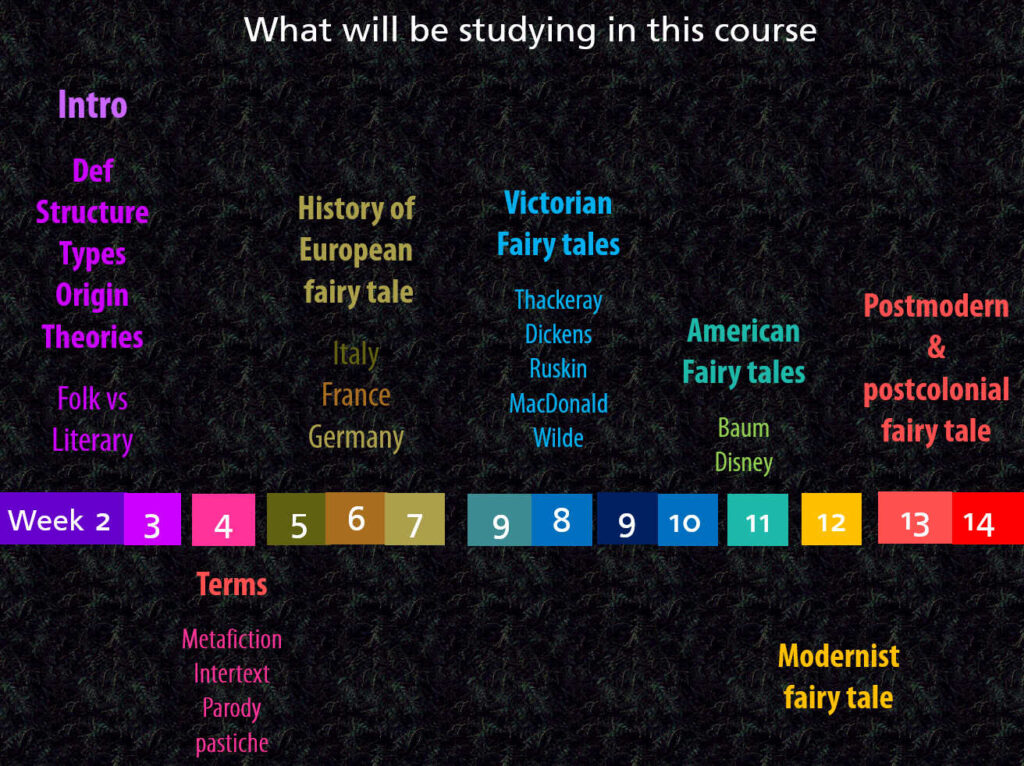
What we will be studying: a bird’s eye view
Courses
I will not post here whole courses, as this masters programme is not of distance learning, but one that requires your physical attendance. If we broadcast our meetings in class we do that just to assist those students who live in distant towns, in some other counties, and those that have a busy work schedule. And not the students from Baia Mare who just wish to an early start of their weekends.
I will post just a few slides that contain basic information. The explanation and context for those can be found by attending my lectures.
Seminars, books & contexts
Before you start. All the texts will be made available on this website. They will not be posted in the PDF format many of you seem to like for all the right reasons. I explain here Why PDF is the worst format for reading books.
All the books will be posted in the EPUB format which is the one used for e-books to be read on e-readers that are competitors to the Kindle. You do not need to own an e-reader to read these files though (even though that would make a great Christmas present…). A very recently launched app can transform any device into an alternative to e-readers
(minus the e-ink, minus the Comfort light, plus the eyestrain).
Meet Readest, the best ebook reading app! Take time to read my full tutorial.
New words for old devices
- New devices in the new fairy tales. Read the texts that will be discussed in class.
The Italian beginnings
Gianfranco Straparola’s Pleasant Nights. Brief presentation and access to the book.
Gianbattista Basile’s Tale of Tales. The author, history of its book. Illustrators. The whole volume at your disposal for you to pick up 3 stories from it.
The French: Imagination versus Discipline
The Bluestocking ladies or Les Salonnières Imagination set free!
Perrault, or Disciplining the Fairy Tale.
Exam materials
Sources of European Fairy Tales – an extensive list of links to collections of fairy tales from various countries of Europe.
Past theses on the fairy tale
If you wish to get an idea of the range of approaches to the fairy tale that our former MA students have embraced, here is an Archive of Dissertations on the Metafictional Fairy Tale.